Dust and slurry equipment
Discover our air cleaners, dust extractors, dust collectors, pre-separators, slurry and wet vacuums.


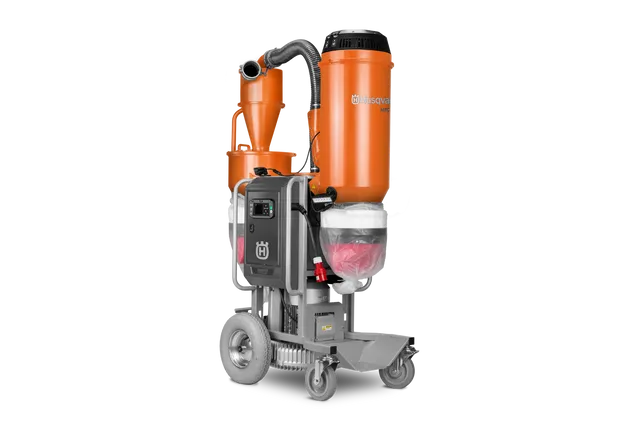


A complete solution for efficient dust management
Inadequate dust extraction can cause dust to accumulate in tools, reducing efficiency and necessitating extra maintenance. Failing to manage dust at the source means time is wasted on additional dust removal, further decreasing efficiency.
Dust particles hovering in the air at construction sites contain several different substances. Some of these, such as crystalline silica, can be harmful or irritating if inhaled.
These respirable particles can penetrate deep into the lungs and may cause serious injuries. They are so small that they might hover in the air for days, invisible to the naked eye.
This is why it’s important to use work methods that catch dust at the source and prevent it from becoming airborne. To handle dust effectively, use high-quality professional dust control equipment and personal protective equipment that can filter even the smallest silica particles.
The respirable dust particles of crystalline silica are so small (0.1–5.0 μm) that equipment with a HEPA H13 or H14 filter is required in addition to the pre-filter.
Frequently Asked Questions
What is dust management equipment?
Dust management equipment is designed to capture, contain, and remove airborne dust and debris generated during construction, concrete cutting, grinding, drilling, demolition, and surface preparation. Common dust control equipment includes dust extractors, dust collectors, air scrubbers, pre-separators, and slurry vacuums. These systems help improve air quality, maintain efficient jobsites, and support effective dust collection and dust management across a wide range of construction applications.
Why is dust control important in construction?
Construction activities can generate large amounts of airborne dust, including respirable crystalline silica from concrete, masonry, and stone. Effective dust control helps improve jobsite efficiency, maintain cleaner working conditions, reduce equipment contamination, and support compliance with dust-control regulations. Proper dust management can also improve productivity by reducing cleanup time and maintaining visibility in active work areas.
What is the difference between a dust extractor and an air scrubber?
A dust extractor captures dust directly at the source by connecting to tools such as grinders, saws, and drills. An air scrubber filters airborne dust and contaminants that are already circulating throughout the workspace. When used together, dust extractors and air scrubbers provide a comprehensive dust management solution by controlling dust both at the source and in the surrounding air.
How do I choose the right dust management equipment?
The best dust management equipment depends on the application, the volume of dust or slurry being generated, and how the material needs to be controlled. Dust extractors are ideal for capturing dust at the source, air scrubbers help improve indoor air quality, pre-separators increase dust collection efficiency, and slurry vacuums collect wet waste generated during cutting, drilling, and grinding. Choosing the right combination of equipment helps maximize dust control and jobsite productivity.
What is silica dust?
Silica dust, also known as respirable crystalline silica, is a fine airborne particle created when materials such as concrete, brick, stone, and masonry are cut, ground, drilled, or demolished. Because these particles are extremely small, they can remain suspended in the air and be inhaled. Dust extractors, air scrubbers, and other dust management equipment help capture silica dust and reduce airborne exposure during construction and surface preparation work.


